How Has Theather Stages Been Important to Venetian Art

Venetian painting was a major strength in Italian Renaissance painting and beyond. Get-go with the piece of work of Giovanni Bellini (c. 1430–1516) and his brother Gentile Bellini (c. 1429–1507) and their workshops, the major artists of the Venetian school included Giorgione (c. 1477–1510), Titian (c. 1489–1576), Tintoretto (1518–1594), Paolo Veronese (1528–1588) and Jacopo Bassano (1510–1592) and his sons. Considered to give primacy to colour over line,[i] the tradition of the Venetian school contrasted with the Mannerism prevalent in the rest of Italy. The Venetian style exerted dandy influence upon the subsequent development of Western painting.[2]

By chance, the main phases of Venetian painting fit rather neatly into the centuries. The glories of the 16th century were followed by a great autumn-off in the 17th, only an unexpected revival in the 18th,[3] when Venetian painters enjoyed neat success around Europe, every bit Baroque painting turned to Rococo. This had concluded completely by the extinction of the Republic of Venice in 1797 and since then, though much painted past others, Venice has not had a continuing style or tradition of its own.[4]
Though a long decline in the political and economic ability of the Democracy began before 1500, Venice at that date remained "the richest, most powerful, and about populous Italian city"[5] and controlled significant territories on the mainland, known every bit the terraferma, which included several pocket-size cities who contributed artists to the Venetian school, in detail Padua, Brescia and Verona. The Republic'south territories too included Istria, Dalmatia and the islands now off the Croation coast, who also contributed. Indeed, "the major Venetian painters of the sixteenth century were rarely natives of the urban center" itself,[vi] and some mostly worked in the Republic's other territories, or further afield.[seven]
The balance of Italy tended to ignore or underestimate Venetian painting; Giorgio Vasari's neglect of the school in the commencement edition of his Lives of the Well-nigh Excellent Painters, Sculptors, and Architects in 1550 was so conspicuous that he realized he needed to visit Venice for extra textile in his second edition of 1568.[8] In contrast, foreigners, for whom Venice was oft the beginning major Italian city visited, always had a peachy appreciation for information technology and, after Venice itself, the best collections are now in the large European museums rather than other Italian cities. At the meridian, princely, level, Venetian artists tended to exist the most sought-after for commissions abroad, from Titian onwards, and in the 18th century nigh of the best painters spent significant periods abroad, more often than not with corking success.[9]
Media and techniques [edit]
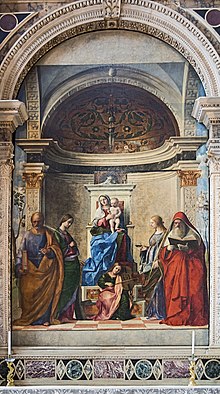
Venetian painters were amongst the kickoff Italians to use oil painting,[ten] and as well to paint on canvas rather than wooden panels. As a maritime ability skilful quality sail was ever available in Venice, which was also beginning to run rather short of timber. The large size of many Venetian altarpieces (for example Bellini'south San Zaccaria Altarpiece of 1505, originally on panel) and other paintings encouraged this, as big console surfaces were expensive and difficult to construct.
The Venetians did not develop a "native school" of fresco painting, oftentimes relying on Padua and Verona, Venetian from 1405, to supply painters (notably Paolo Veronese). They continued to add together gold ground mosaics to San Marco long afterwards the rest of Europe had abased the medium. Somewhat perversely, they were happy to add frescos to the outside of palazzi, where they deteriorated fifty-fifty faster than elsewhere in Italy, and take merely left a few shadowy traces, but apart from the Doge'southward Palace, used them little in other interior settings. The rapid deterioration of external frescos is often attributed to the seaside Venetian climate, maybe wrongly.[11] Probably partly for this reason, until the 18th century (with rare exceptions) Venetian churches were never given a coherent scheme of ornamentation, merely feature a "rich profusion of different objects in a picturesque confusion", oft with much wall infinite taken upwards by grandiose wall-tombs.[12]
Compared to Florentine painting, Venetian painters mostly used and accept left fewer drawings.[thirteen] Peradventure for this reason, and despite Venice existence Italian republic'due south largest centre of printing and publishing throughout the Italian Renaissance and for a considerable time afterwards, the Venetian contribution to printmaking is less than might be expected. Like Raphael, Titian experimented with prints, using specialist collaborators, merely to a lesser extent. The engraver Agostino Veneziano moved to Rome in his twenties, and Giulio Campagnola and his adoptive son Domenico Campagnola are the main 16th-century artists who full-bodied on printmaking and remained in the Republic of Venice, apparently mostly in Padua.[14] The state of affairs was different in the 18th century, when both Canaletto and the two Tiepolos were pregnant etchers, and Giovanni Battista Piranesi, though famous for his views of Rome, continued to describe himself every bit a Venetian for decades after moving to Rome.[fifteen]
Early development, to 1500 [edit]
14th century [edit]
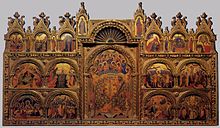
Paolo Veneziano, probably active between about 1320 and 1360, is the beginning major figure we can name, and "the founder of the Venetian school". He seems to have introduced the "composite altarpiece" of many small scenes within an elaborate gilded wooden frame, which remained dominant in churches for 2 centuries. These transferred to painting the form of the huge, precious stone-encrusted and very famous Pala d'Oro behind the principal chantry in San Marco, the enamel panels for which had been made in, and afterward looted from, Constantinople for successive doges.[16] In fact, one of Veneziano's commissions was to pigment "weekday" panels to fit over the Pala, which was only revealed for feast-days. His style shows no influence from Giotto, active a generation earlier.[17]
The earliest grade of Italian Renaissance painting was first seen in Venice when Guariento di Arpo from Padua was commissioned to paint frescos in the Doge's Palace in 1365.
15th century [edit]
The traditional Italo-Byzantine style persisted until around 1400 when the dominant style began to shift towards International Gothic, with Jacobello del Fiore a transitional figure and the trend, which connected in the rather charming work of Michele Giambono (c. 1400 – c. 1462), who besides designed mosaics for San Marco. Gentile da Fabriano and Pisanello were both in Venice during much of the years 1405–1409, painting frescos (now lost) in the Doge's Palace and elsewhere.[18]
Past the mid-century, when the Florentine quattrocento was fully mature, Venice still lagged well behind. Perhaps the most visible work in Venice in the Tuscan style was a mosaic Death of the Virgin, in the Capella Mascoli in San Marco, side by side to a design past Gambono, though other works in the metropolis included frescos by Andrea Castagno.[19] The Vivarini and Bellini families were the two major dynasties of 15th-century painters in the city, and the Vivarini, though in the end more bourgeois, were initially the first to embrace styles from the south.[20]
Carlo Crivelli (c. 1430–1495) was born in the city, but spent his mature career outside the Republic'due south territories. His fashion – highly individual, rather linear, and somewhat neurotic – had no influence on later on Venetian painting.[21]
From the late-15th century, Venetian painting developed through links with Andrea Mantegna (1431–1506) (from nearby Padua) and of a visit past Antonello da Messina (c. 1430–1479), who introduced the oil painting technique of Early Netherlandish painting, probably acquired through his training in Naples.[22] Some other external gene was the visit by Leonardo da Vinci, who was particularly influential on Giorgione.[23]
During his long career, Giovanni Bellini has been credited with creating the Venetian style.[2] Subsequently earlier works, such as his Madonna of the Small Trees (c. 1487), which largely reflect the linear approach of Mantegna, he later developed a softer fashion, where glowing colours are used to represent form and suggest an atmospheric haze. Applying this arroyo in his San Zaccaria Altarpiece (1505), the high viewpoint, the uncluttered and interconnected figures bundled in space, and the subtle gestures all combine to form a tranquil yet royal image.[24] With such works he has been described as reaching the High Renaissance[24] ideals, and certainly expresses the cardinal distinctive factors of the Venetian school.
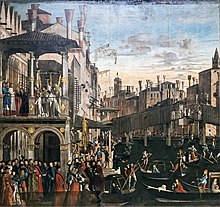
Vittore Carpaccio (c. 1465–1525/1526) was a educatee of Bellini, with a distinct fashion. He was rather bourgeois, and ignored the High Renaissance way developing in the later part of his career, indeed retaining a Late Gothic poetry in many works. With Gentile Bellini, many of Carpaccio'south big works give usa famous scenes of contemporary life in the urban center; at this period such views were unusual. He was one of the first painters to by and large use sail rather than panels. There were a number of other painters who connected essentially quattrocento styles in the two decades later on 1500; Cima da Conegliano (c. 1459–c. 1517) is the nearly significant.[25]
16th century [edit]
Giorgione and Titian [edit]

Titian'southward early and dramatically composed Pesaro Madonna (1526), with rich Venetian colouring
Giorgione and Titian were both apprentices at Bellini's workshop. They collaborated on numerous paintings, and their styles could exist so similar that information technology is difficult to conclusively assign authorship. A speciality of Giorgione's were idyllic Arcadian scenes, with an instance being his Iii Philosophers, and this chemical element was adopted by his master Bellini, who increased the mural in his many Madonnas,[26] and by Titian in piece of work similar Pastoral Concert (1508) and Sacred and Profane Love (1515). This emphasis on nature as a setting was a major contribution of the Venetian School.
Titian, through his long and productive life, with a broad variety of themes and subjects was the most influential and greatest of all the Venetian painters.[27] [28] His early on Pesaro Madonna (1519–1528) shows a bold new composition for such a traditional religious field of study,[29] putting the focal point of the Madonna off from the centre and on a steep diagonal. Colours are used to enliven the painting, only too to unify the composition, such equally by the large red flag on the left counterbalancing the red in the Madonna[xxx] and such adept and sumptuous use of colour became a hallmark of the Venetian style.

Titian's reclining Venus of Urbino (1538), with a lapdog on the right, balancing the face on the left, is an erotic work.
Although pre-figured past the Sleeping Venus (completed past Titian after Giorgione'due south expiry in 1510) Titian is credited with establishing the reclining female person nude as an important subgenre in art. Using mythological subjects, works such as the Venus of Urbino (1538) richly describe the fabrics and other textures, and use a composition that is carefully controlled by organising colours. Every bit an example, in this painting the diagonal of the nude is matched by the opposite diagonal between the red of the cushions in the forepart with the blood-red skirts of the woman in the background.[31]
With other Venetian painters such every bit Palma Vecchio, Titian established the genre of half-length portraits of imaginary cute women, often given rather vague mythological or allegorical titles, with attributes to match. The artists apparently did nothing to discourage the conventionalities that these were modelled for by the most celebrated of Venice's famous courtesans, and sometimes this may have been the case.
Titian continued to pigment religious subjects with growing intensity, and mythological subjects, which produced many of his most famous afterwards works, above all the poesie series for Philip II of Spain.
With such paintings, readily transported by virtue of existence oils on sail, Titian became famous, and helped establish a reputation for Venetian art. Possession of such paintings symbolised luxurious wealth,[32] and for his skills in portraiture he was sought by powerful, rich individuals, such as in his long human relationship working for Emperor Charles V and Philip Ii of Spain.[33] [34]
Afterward Giorgione [edit]

Miracle of the Slave (1548), one of a trio of Tintoretto works on St Mark, the patron saint of Venice
The long dominance of Titian in the Venetian painting scene could be a problem for other aggressive Venetian painters. Palma Vecchio (c. 1480–1528) was slightly older than Titian, and apparently content to follow in the wake of the two great innovators; many easel paintings long attributed to Titian may actually be past him.[35] His neat-nephew, Palma il Giovane (1548/50–1628), Titian'south educatee, much later played a similar role, using the styles of Tintoretto and Veronese.[36]
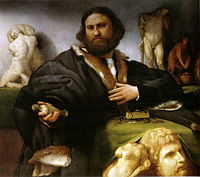
Lorenzo Lotto (c. 1480–1556/57) was born in the city, just spent nigh of his mature career in the terraferma, especially Bergamo. He painted religious subjects and portraits in a highly individual and sometimes eccentric mode, which despite their rich colouring take a restlessness that is at odds with the Venetian mainstream.[37]
Sebastiano del Piombo (c. 1485–1547) accepted a skillful commission in Rome in 1511, and never worked in Venice again. But in Rome he presently found that Michelangelo was as dominant, and began a long and complicated relationship with him; eventually they fell out. His way combined Venetian colour and Roman classical grandeur, and did something to spread Venetian mode to the new centre of Italian painting.[38]
Paolo Veronese (1528–1588), from Verona in the Venetian terraferma, came to Venice in 1553, once he was established, deputed to paint huge fresco schemes for the Doge'southward Palace, and stayed for the rest of his career.
Although Tintoretto is sometimes classified as a Mannerist artist,[39] he also incorporates Venetian and individualistic aspects. In his Miracle of the Slave (1548), the Mannerist features include the crowded scene, the twisting linking of figures (equally in the central figures, from the foreshortened slave on the ground to the miraculous figure of St. Mark in the sky, through the turbaned, grey-robed effigy), and the drama in the gestures and poses. Merely the colouring maintains the warm reds, golds and greens of the Venetian school, and the figures are bundled in real three-dimensional space, in contrast to the more compressed compositions of many Mannerist works, and with its intensely theatrical, stage-similar display his painting is a precursor of the Bizarre.[twoscore]
Jacopo Bassano (c. 1510–1592), followed by the four sons in his workshop, developed an eclectic style, with influences not but from Titian but a range of other painters, which he then utilized for decades from his modest hometown of Bassano del Grappa, some 65 km from Venice. His sons continued to piece of work in information technology long after his death; Baroque painting was very slow to appeal to the Venetian marketplace.[41]
These are a few of the most outstanding in the peachy number of artists in the Venetian tradition, many originally from outside the Republic's territory.

17th century [edit]

The 17th century was a low bespeak in Venetian painting, specially in the first decades when Palma Giovane, Domenico Tintoretto (the son), the Bassani sons, Padovanino and others continued to turn out works essentially in the styles of the previous century. The well-nigh pregnant artists working in the city were all immigrants: Domenico Fetti (c. 1589–1623) from Rome, Bernardo Strozzi (c. 1581–1644) from Genoa, and the north German Johann Liss (c. 1590? – c. 1630). All were aware of the Baroque painting of Rome or Genoa, and in different ways developed styles reflecting and uniting these and traditional Venetian handling of paint and colour.[43]
New directions were taken past two individual painters, Francesco Maffei from Vicenza (c. 1600–60) and Sebastiano Mazzoni from Florence (1611–78), who both worked mainly in Venice or the terraferma in unorthodox and free Baroque styles, both marked past the Venetian trait of bravura brushwork.[44]
Visits to Venice by the leading Neapolitan painter Luca Giordano in 1653 and 1685 left a body of work in the latest Bizarre style, and had an energising consequence on younger artists such equally Giovan Battista Langetti, Pietro Liberi, Antonio Molinari, and the German language Johann Carl Loth.[45]
18th century [edit]
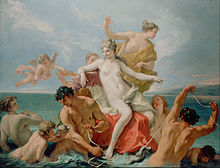

At the end of the 17th century things began to modify dramatically, and for much of the 18th century Venetian painters were in remarkable demand all over Europe, fifty-fifty as the city itself declined and was a much reduced market, in particular for large works;[46] "Venetian art had go, by the mid-eighteenth century, a commodity primarily for export."[47] The first pregnant artist in the new style was Sebastiano Ricci (1659–1734), from Belluno in the terraferma, who trained in Venice earlier leaving nether a cloud. He returned for a decade in 1698, and and so over again at the end of his life, after time in England, France and elsewhere. Cartoon especially on Veronese, he developed a light, airy, Baroque way that foreshadowed the painting of nigh of the residuum of the century, and was a great influence on young Venetian painters.[48]
Giovanni Antonio Pellegrini was influenced by Ricci, and worked with his nephew Marco Ricci, but also by the subsequently Roman Baroque. His career was mostly spent away from the city, working in several countries due north of the Alps, where the new Venetian style was greatly in demand for decorating houses. It was actually slower to be accepted in Venice itself. Jacopo Amigoni (a. 1685–1752) was another travelling Venetian decorator of palaces, who was too popular for proto-Rococo portraits. He ended as a courtroom painter in Madrid.[49] Rosalba Carriera (1675–1757), the about significant Venetian adult female artist, was purely a portraitist, mostly in pastel, where she was an important technical innovator, preparing the manner for this important 18th-century class. She accomplished nifty international success, in detail in London, Paris and Vienna.[50]
Giovanni Battista Tiepolo (1696–1770) is the last great Venetian painter, who was also in demand all over Europe, and painted ii of his largest fresco schemes in the Würzburg Residence in northern Bavaria (1750–53) and the Regal Palace of Madrid, where he died in 1770.[51]
The final flowering besides included the varied talents of Giambattista Pittoni, Canaletto, Giovan Battista Piazzetta, and Francesco Guardi, as well as Giovanni Domenico Tiepolo, the about distinguished of several of the family unit to railroad train with and assist Giovanni Battista Tiepolo. [52]
Canaletto, his educatee and nephew Bernardo Bellotto, Michele Marieschi, and Guardi specialized in landscape painting, painting ii distinct types: firstly vedute or detailed and by and large accurate panoramic views, usually of the city itself, many bought past wealthy northerners making the Grand Tour. Few Canalettos remain in Venice. The other blazon was the capriccio, a fanciful imaginary scene, oft of classical ruins, with staffage figures. Marco Ricci was the kickoff Venetian painter of capricci, and the course received a terminal development past Guardi, who produced many freely painted scenes set in the lagoon, with water, boats and country in "paintings of great tonal delicacy, whose poetic mood is tinged with nostalgia".[53]
Pietro Longhi (c. 1702–1785) was Venetian painting'due south most significant genre painter, turning early in his career to specialize in pocket-sized scenes of contemporary Venetian life, more often than not with an element of gentle satire. He was 1 of the starting time Italian painters to mine this vein, and was also an early painter of chat slice portraits. Unlike most Venetian artists, large numbers of lively sketches past him survive.[54]
The death of Guardi in 1793, before long followed by the extinction of the Republic by French Revolutionary armies in 1797, effectively brought the distinctive Venetian style to an end; it had at least outlasted its rival Florence in that respect.[55]

Legacy [edit]

Francesco Guardi, View of the Venetian Lagoon with the Tower of Maghera, 1770s, 21.3 cm (viii.3 ″) x 41.3 cm (16.two ″)
The Venetian school had a not bad influence of subsequent painting, and the history of later Western fine art has been described as a dialogue between the more intellectual and sculptural/linear approach of the Florentine and Roman traditions, and the more sensual, poetic, and pleasance-seeking of the colourful Venetian schoolhouse.[56] Specifically through the presence of Titians in Spain (he was careful to avert going there in person), the Venetian fashion influenced later Castilian art, peculiarly in portraits, including that of Velázquez, and through Rubens was more broadly transmitted through the rest of Europe.[57]
Venice as a subject for visiting artists has been extremely pop, specially from shortly after Venetian artists ceased to be significant. Among the best known to frequently describe the urban center are J.M.Due west. Turner, James Abbott McNeill Whistler and Claude Monet.
See also [edit]
- List of painters and architects of Venice
Notes [edit]
- ^ Steer, seven-x; Martineau, 38-39, 41-43
- ^ a b Gardner, p. 679.
- ^ Steer, 175 describes the crusade of the revival as "something of a mystery"; it is as well a "mystery" to Wittkower, 479.
- ^ Steer, 208
- ^ Freedberg, 123
- ^ Freedberg, 123
- ^ In the 16th century, Lorenzo Lotto, Carlo Crivelli and others; in the 18th century most major Venetian painters spent long periods abroad (run into below).
- ^ Martineau, 38-39
- ^ Martineau, 47-48
- ^ Steer, 58-59
- ^ Steer, 28 quoted; Penny, xiii
- ^ Steer, 16
- ^ Martineau, 243-244
- ^ Martineau, 303-305
- ^ RA, 21
- ^ Steer, 11, 15-22 (15 quoted)
- ^ Steer, 22
- ^ Steer, 28-33
- ^ Steer, 35-36
- ^ Steer, 36-43
- ^ Steer, 43-44
- ^ Prado Guide, p. 223.
- ^ Prado Guide, p. 248.
- ^ a b Gardner, p. 681.
- ^ Steer, 66-68, 90; Freedberg, 166; Martineau, 66
- ^ Gardner, pg. 680
- ^ Gardner, p. 684
- ^ Prado Guide, p. 248
- ^ Gardner, p. 685
- ^ Gombrich, p. 254
- ^ Gardner, p. 686
- ^ Prado Guide, p. 244
- ^ Prado Guide, p. 254
- ^ Gardner, p. 687
- ^ Steer, 101-102
- ^ Steer, 131, 144, 169
- ^ Steer, 103-106; Martineau, 33, 175-182
- ^ Steer, 92-94
- ^ Gombrich, p. 283
- ^ Gardner, p. 688
- ^ Steer, 146-148, 169
- ^ Steer, 114-116
- ^ Steer, 169-174; Wittkower, 106-108
- ^ Wittkower, 348; Steer, 173-174. They differ markedly in their evaluation of Maffei.
- ^ Wittkower, 347-349; Steer, 174
- ^ Steer, 175-177
- ^ Steer, 201
- ^ Steer, 176-177; Wittkower, 479-481
- ^ Steer, 179-180
- ^ Steer, 132
- ^ Steer, 186-195
- ^ Steer, 180-186; Wittkower, 481-484
- ^ Steer, 198-208; Wittkower, 491-505
- ^ RA, 277-278; Steer, 198; Wittkower, 496-497
- ^ Steer, 208
- ^ Gardner, pp. 682–683.
- ^ Martineau, 47-48; Prado Guide, p. 118.
References [edit]
- Freedburg, Sidney J. Painting in Italy, 1500–1600, 3rd edn. 1993, Yale, ISBN 0300055870
- Gardner's: Art Through the Ages—International Edition, Brace Harcourt Jovanovich, 9th edition, 1991.
- "RA": Martineau, Jane (ed), The Genius of Venice, 1500–1600, 1983, Royal Academy of Arts, London.
- Martineau, Jane, and Robison, Andrew, eds., The Glory of Venice: Art in the Eighteenth Century, 1994, Yale University Press/Regal Academy of Arts, ISBN 0300061862 (catalogue for exhibition in London and Washington).
- Penny, Nicholas, National Gallery Catalogues (new serial): The Sixteenth Century Italian Paintings, Book II, Venice 1540–1600, 2008, National Gallery Publications Ltd, ISBN 1857099133
- The Prado Guide, Ed. Maria Dolores Jimenez-Blanco, Museo National Del Prado, English second revised edition, 2009.
- Steer, John, Venetian painting: A concise history, 1970, London: Thames and Hudson (World of Art), ISBN 0500201013
- Wittkower, Rudolf, Fine art and Architecture in Italy, 1600–1750, Penguin/Yale History of Art, third edition, 1973, ISBN 0-14-056116-i
Further reading [edit]
- Rosand, David, Painting in Sixteenth-Century Venice: Titian, Veronese, Tintoretto, 2nd ed 1997, Cambridge Upwards ISBN 0521565685
- Federico Zeri, Elizabeth E. Gardner: Italian Paintings: Venetian School: A Catalogue of the Drove of the Metropolitan Museum of Fine art, (New York, Northward.Y.) (online)
External links [edit]
Source: https://en.wikipedia.org/wiki/Venetian_painting

Post a Comment for "How Has Theather Stages Been Important to Venetian Art"